Cold floors in winter. Drafts pushing up through the boards. An energy bill that climbs every year despite your best efforts. If this sounds familiar and you own a raised timber floor home, underfloor insulation is almost certainly part of the answer. The question is whether spray foam is the right material for your situation, and whether the cost makes sense.
What is Underfloor Spray Foam Insulation?
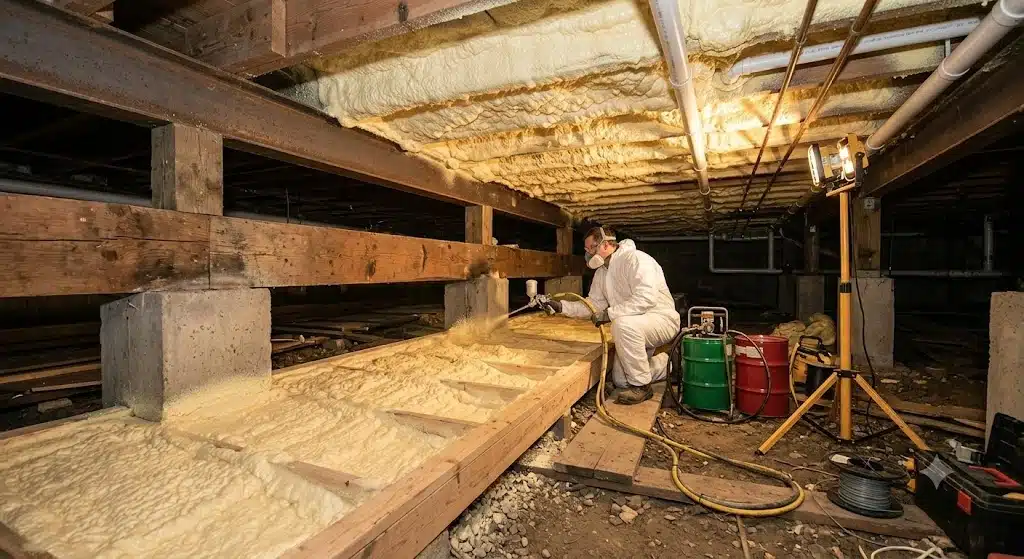
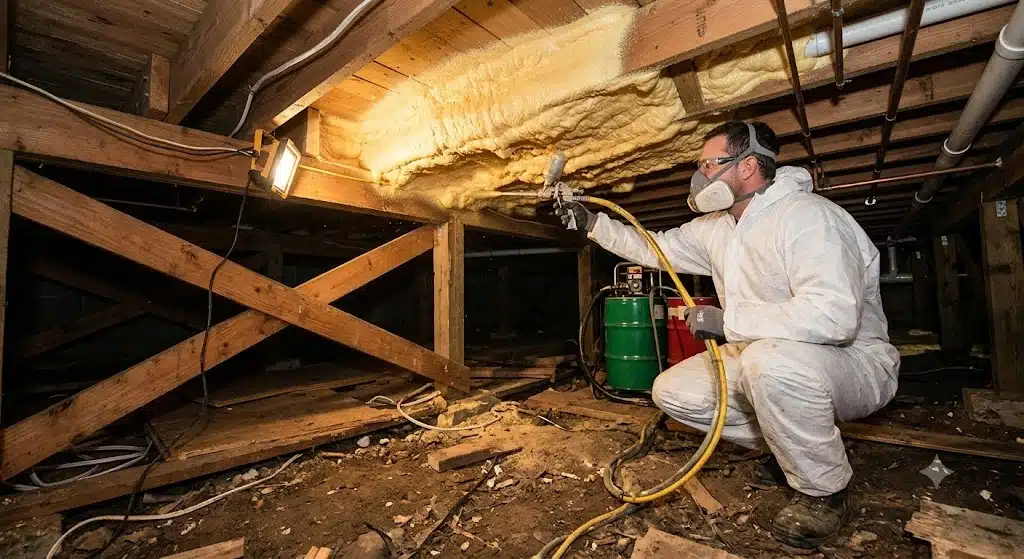
Spray foam underfloor insulation is a closed-cell or open-cell polyurethane foam applied directly beneath the floorboards of a raised timber home. A trained applicator sprays it as a liquid onto the underside of the floor from the subfloor space below. It expands on contact, filling gaps and voids before curing into a rigid, continuous insulating layer.
Unlike glasswool batts or rigid panels, which are cut to fit between joists and held in place mechanically, spray foam adheres to the timber and conforms to any shape. There are no gaps at joist edges, no sagging over time, and no spaces where air can bypass the insulation. The result is thermal insulation and an airtight seal delivered in a single application. For most raised timber floor homes, closed-cell foam is the preferred underfloor product, offering higher R-values per inch and a built-in moisture barrier.
The Real Benefits (What the Data Shows)
Under-floor spray foam insulation addresses a genuine energy problem. The Australian Government’s Your Home guide notes that uninsulated floors can account for 10–20% of a home’s total heat loss, and Sustainability Victoria recommends floor insulation (typically R2.0 in Victoria) to reduce that loss.
Thermal Performance
Closed-cell spray foam is typically applied at 25mm, 40mm, or 50mm thickness under floors, achieving R-values of R1.1, R1.8, and R2.2 respectively. While those numbers may look modest on paper, spray foam also functions as a continuous air barrier, which means it eliminates the drafts and air leakage that undermine the performance of traditional insulation products. In practice, a thinner layer of spray foam often outperforms higher R-value alternatives that still allow air movement through and around them.
Complete Air Sealing
Air movement through the subfloor is a major contributor to cold floors and drafts. Spray foam eliminates this by forming an airtight barrier across the entire floor surface, including around pipes, wiring, and irregular joist edges.
Moisture Barrier
Closed-cell foam does not absorb moisture. In Sydney’s humid climate, subfloor spaces are prone to condensation and rising damp. A foam barrier beneath the floor helps prevent moisture from reaching the timber above, reducing the risk of rot, mould, and structural damage accumulating over time.
Pest Deterrent
Unlike glasswool batts, which rodents are known to nest in and damage, cured polyurethane foam provides no nesting opportunity and holds no appeal to pests. This is a practical advantage in older Sydney homes where subfloor pest activity is a known issue.
Longevity
Correctly installed under-floor spray foam insulation doesn’t sag, compress, or degrade. It adheres permanently to the timber substrate and should remain effective for the lifetime of the building, removing the need for future replacement.
Claims of 30-40% heating efficiency improvement are sometimes cited for spray foam applications. These figures reflect best-case scenarios in which significant air leakage is addressed; real-world results will vary depending on the home’s existing condition, climate zone, and overall building envelope performance.
When Spray Foam Underfloor Insulation Isn’t Worth It
The following are situations where spray foam underfloor insulation likely isn’t the most suitable choice.
Slab-On-Ground Homes
If your home is built on a concrete slab rather than timber piers or stumps, there is no subfloor space to insulate. Slab-edge insulation and in-slab thermal mass strategies are the more relevant approaches for these properties.
Very Low Subfloor Clearance
Safe access to the subfloor typically requires preferably at least 400mm of clearance. Below this threshold, installation becomes difficult, expensive, and in some cases impractical even for spray foam applicators. If your clearance is marginal, a site inspection will confirm what is achievable before any commitment is made.
Tight Budgets & Modest Performance Expectations
Spray foam costs more upfront than glasswool batts. If you need the most affordable way to take the edge off cold floors and the space has good access and standard joist spacing, properly installed batts may be adequate and offer better value in the short term.
Homes Likely To Be Sold Within 1-2 Years
Spray foam delivers its financial return through compounding energy savings over time. If you are planning to sell in the near future, the upfront investment may not be recouped before the property changes hands. A lower-cost insulation option is generally the more practical choice in this situation.
Spray Foam vs Batts vs Foil For Underfloor
The table below compares the three most commonly used underfloor insulation approaches across key performance criteria.
| Feature | Spray foam (closed-cell) | Glasswool batts | Reflective foil |
| R-value per 100mm | R4.4 | R2.0–R2.5 | Air-gap dependent |
| Air sealing | Complete | Partial | No |
| Moisture resistance | Excellent | Poor | Good |
| Lifespan | 50+ years | 15–20 years | 20–30 years |
| Approx. installed cost per m2 | From $35 | $25–$30 | $15–$20 |
What Spray Foam Underfloor Insulation Costs
Spray foam underfloor insulation is priced based on the area to be covered, the required foam thickness, and how easily the subfloor can be accessed. A straightforward job on a standard weatherboard home with good clearance will cost considerably less than a difficult retrofit with low clearance, debris, and irregular pipe runs.
General pricing across the industry for closed-cell spray foam applied beneath timber floors ranges from $35 to $ 60+ per square metre installed, though this varies significantly between projects. Batts and foil products are significantly cheaper upfront.
The correct way to evaluate this investment is over time, not on day one. Spray foam applied today should not need to be replaced for the life of the building. Batts in an underfloor environment typically need to be replaced after 2 decades as they sag, absorb moisture, and lose performance. Factor in annual energy savings of 10-15% on your heating and cooling bill, and the total cost of ownership over 15-20 years often narrows the gap considerably.
So, Is It Worth It?
Spray foam underfloor insulation is genuinely worth it for most Sydney residential properties built on raised timber floors. The combination of thermal performance, complete air sealing, moisture resistance, and longevity delivers results that no other single material can match at comparable thickness.
If your home is on a slab, your clearance is very low, your budget is tight, or you’re selling soon, there are other paths worth exploring.
Book Your Free Site Inspection
If you’re seriously considering underfloor spray foam insulation for your home, the next step is a free site inspection with Foamed Insulations. We will assess your subfloor clearance, floor area, and access conditions and provide a fixed-price quote with no guesswork.
If spray foam isn’t the right fit for your situation, we’ll tell you that too.
Call 02 9898 0751 to book.
Spray Foam Underfloor Insulation FAQs
Is spray foam underfloor insulation worth the cost in Australia?
For most homes on raised timber floors, the long-term value is strong. The upfront cost is higher than batts, but when you factor in the complete air seal, moisture resistance, and 50+ year lifespan with no replacement costs, the total investment over time is often comparable or lower.
How long does spray foam underfloor insulation last?
Correctly installed closed-cell spray foam adheres permanently to the timber substrate and does not sag, compress, or degrade. It should remain effective for the lifetime of the building, typically 50 years or more, without any maintenance or replacement.
Can spray foam be applied under existing timber floors?
Spray foam underfloor insulation is most commonly applied as a retrofit beneath existing raised timber floors, from the subfloor space below. No removal of floorboards is required. The main requirement is adequate subfloor clearance, generally 400mm or more for safe access.
What R-value does underfloor spray foam insulation achieve?
Closed-cell spray foam achieves R1.1 at 25mm, R1.8 at 40mm, and R2.2 at 50mm. These values meet or exceed the NCC minimum of R1.5–R2.5 for underfloor insulation in most NSW climate zones, and the additional air sealing properties of spray foam mean its real-world performance often surpasses products with a higher rated R-value.
Is spray foam underfloor insulation safe for homes?
Yes. Once cured, closed-cell polyurethane foam is chemically inert and does not off-gas or emit fumes. Installation requires professional equipment and adequate ventilation during application. After curing, the product poses no health risk to building occupants.
