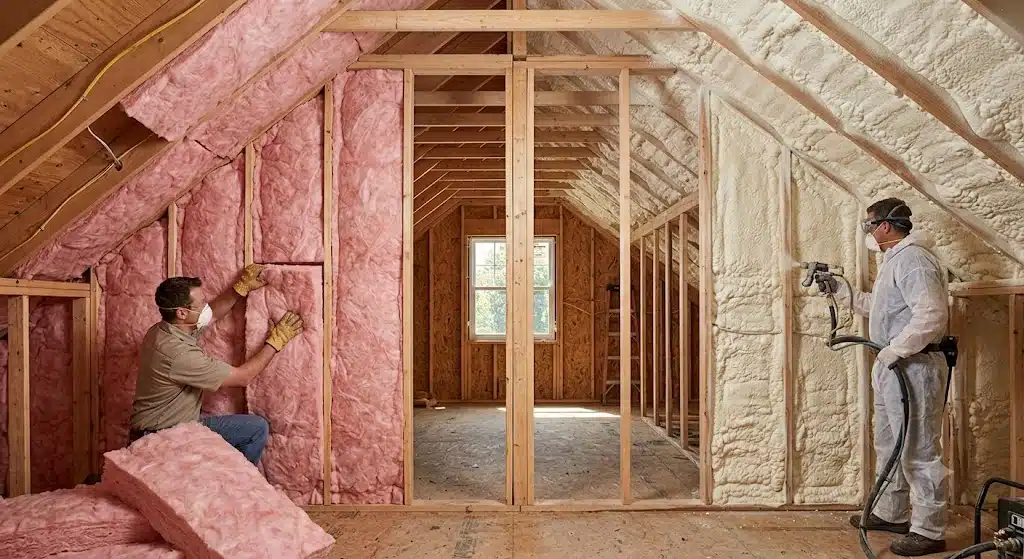
If you’ve started researching residential insulation, you’ve almost certainly landed on this question: the spray foam insulation vs batts debate is one of the most common questions homeowners face, and the answer is rarely a one-size-fits-all. Both are widely used, both have genuine merits, and both have situations where they’re clearly the wrong choice. Here’s how to find out which one is best for you with a straight comparison covering performance, cost, and the specific scenarios where each material makes the most sense.
Where Spray Foam Wins
Spray foam’s key advantage is that it insulates and air-seals in a single application. This matters considerably in the following scenarios.
Underfloor Applications On Raised Timber Homes
Batts and panels in underfloor positions are prone to sagging, moisture absorption, and gaps at joist edges. Closed-cell spray foam adheres directly to the timber, covers every gap, and stays in place permanently. For underfloor insulation on raised timber floors, spray foam routinely outperforms batts regardless of brand or product quality.
Moisture-Prone Areas
Sydney’s coastal humidity, combined with the condensation dynamics in poorly ventilated subfloors, makes moisture resistance a real concern. Closed-cell spray foam provides a vapour barrier as part of the insulation layer, which batts cannot offer. This matters most in subfloor spaces and roof cavities with condensation issues, and any area exposed to seasonal humidity fluctuations.
Hard-To-Access Cavities
The most common application is underfloor spaces where access is limited and traditional batts are difficult to fit or position correctly. For other insulation solutions, see our cavity wall insulation for existing walls.
Long-Term Durability
Spray foam doesn’t compress, sag, or degrade over time. Glasswool batts in particular tend to lose their loft and performance after 15–20 years, especially in underfloor environments where they are exposed to moisture and gravity. Over a 30-year horizon, the maintenance-free nature of spray foam represents meaningful value.
Where Batts Make More Sense
When you look at insulation batts vs spray foam honestly, batts are a genuinely good product in the right application, and saying so plainly makes the spray foam recommendation in other contexts far more credible.
Standard Wall Cavities in New Builds
If wall studs are at standard spacings, the cavity is accessible, and there’s no moisture concern, batts are a fast and cost-effective solution. Professional installation is straightforward, and results are predictable. This is the application for which batts were designed, and they perform well in it, provided the wall cavities are completely air-tight.
Ceiling Installations With Easy Access
A ceiling with good roof space access and standard joist spacing is well-suited to batts. They can be installed quickly, achieve high R-values at relatively low cost, and perform well for many years. In this scenario, the premium for spray foam is rarely justified. A single caveat would again be the amount of air movement inside the roof. If the roof is badly sealed and wind is blowing through the roof space, then the Batt performance will be reduced.
Budget-Conscious Installs Where Moisture Is Not A Factor
If you need to insulate a dry internal wall or ceiling on a tight budget and moisture isn’t a concern, glasswool or polyester batts will do the job effectively and affordably.
DIY Preference
Batts can be installed by confident home handypeople in accessible locations. Spray foam requires professional equipment and trained applicators, so it’s not a DIY option. If you want to handle the job yourself and the application suits batts, they are the practical choice.
Spray Foam Insulation vs Batts Cost: The Real Numbers
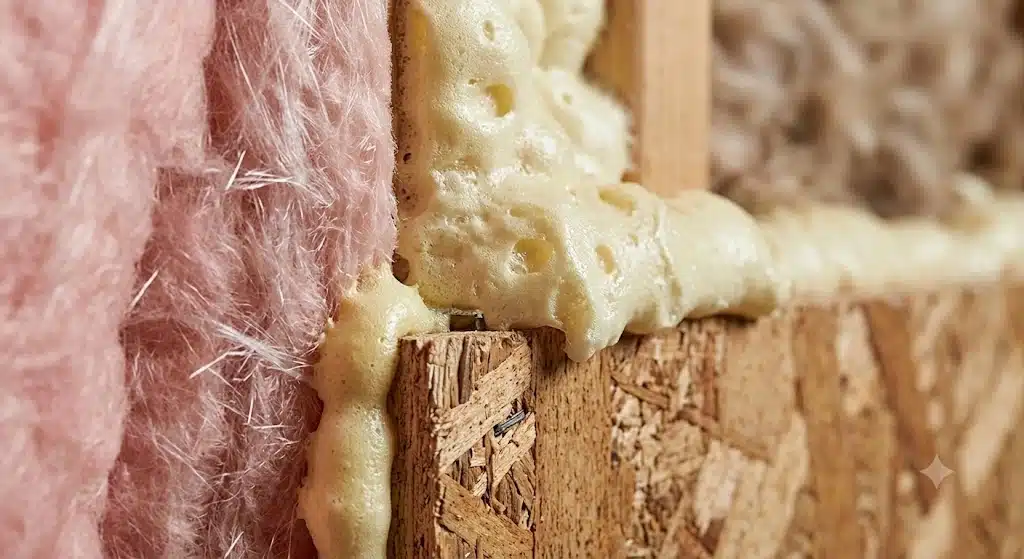
The upfront spray foam insulation vs batt costs is a stark contrast. Glasswool batts typically cost $25–$30 per square metre installed, depending on R-value and access conditions. Polyester batts sit slightly higher at $28–$35 per square metre. Spray foam ranges from $25–$40 per square metre for open-cell applications and $35–$60+ per square metre for closed-cell.
On day one, batts are clearly cheaper. The more useful comparison is total cost of ownership. Batts in an underfloor environment typically need to be replaced after 15–20 years, as they sag and lose performance. Spray foam, when applied correctly, lasts 50+ years with no maintenance.
For a 100m2 floor area, batts installed twice over 30 years might cost $3,000–$4,000 in total. Spray foam installed once might cost $5,000–$6,000. Factor in annual energy savings of 10–15% on a $2,000 heating and cooling bill, and the gap narrows considerably over time.
What About Safety?
Some sources raise concerns about off-gassing and isocyanate exposure from spray foam insulation. These concerns are worth addressing factually.
During installation, uncured spray foam requires professional handling and appropriate PPE. Isocyanates are present during application, and trained applicators manage this process correctly while ensuring proper ventilation.
Once cured, polyurethane foam is chemically inert. It does not off-gas, does not emit fumes, and poses no health risk to building occupants. It belongs to the same broad family of materials as polyurethane mattresses, car seats, and furniture foam. The safety considerations apply to the installation process, not the cured product, and professional installation by trained applicators addresses these entirely.
Which Suits You? A Simple Decision Guide For Spray Foam Insulation vs Batts
Choose batts if: you’re insulating standard ceiling or wall cavities in a new build with easy access; budget is your primary concern, and moisture is not a factor; you want a DIY-friendly option in an accessible location; or you are doing a ceiling install with good roof space access.
Choose spray foam if: you’re insulating beneath raised timber floors; the area has moisture exposure or condensation risk; access is limited, or the cavity is irregular; you want an installation that will last the lifetime of the building without maintenance; or you’re retrofitting an existing home where batts cannot be installed without major works.
Not Sure Which Is Right For Your Home?
Book a free site inspection with Foamed Insulations. We’ll assess your property and recommend the right solution for your budget and performance goals, even if that’s not spray foam. Call 02 9898 0751 to book.
Insulation Batts vs Spray Foam FAQs
Is spray foam insulation better than batts?
It depends on the application. Spray foam is the stronger choice for underfloor use, moisture-prone areas, and hard-to-access cavities. Batts are a strong option for accessible ceiling and wall cavities where moisture isn’t a concern and budget is a priority.
How much more does spray foam cost than batts in Australia?
Spray foam typically costs two to three times more per square metre installed than standard glasswool batts. However, spray foam lasts 50+ years versus 15–20 years for batts in underfloor environments, and delivers energy savings that partially offset the difference over time.
Can spray foam be installed over existing batts?
In all cases, existing batts should be removed before spray foam is applied to ensure proper adhesion and full coverage. Installing spray foam over degraded or moisture-damaged batts would trap moisture and reduce performance. A site inspection will confirm the best approach for your specific situation.
Is spray foam insulation safe for residential use?
Yes. Once cured, spray foam is chemically inert and safe for occupants. The chemical reaction occurs during installation, which requires trained applicators and appropriate ventilation. After curing, the product poses no health risk.
How long does spray foam last compared to batts?
Spray foam installed correctly should last 50 years or more without degradation or maintenance. Glasswool batts in underfloor environments typically need replacing after 15–20 years as they sag and absorb moisture. In well-protected ceiling applications batts can last longer, but spray foam still has a considerable lifespan advantage in most real-world conditions.
