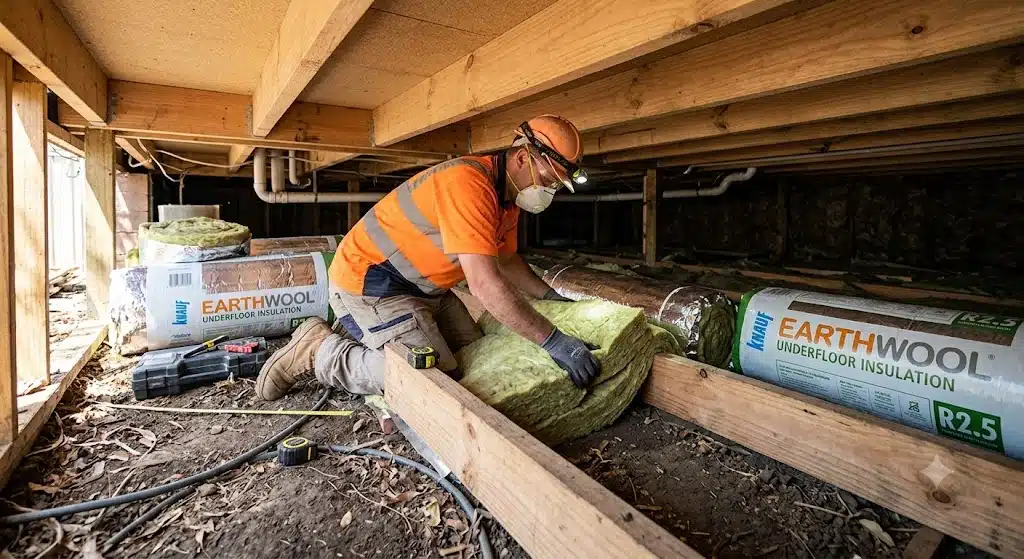
Before you call an insulation company, you want to know what you’re most likely to pay. That’s a reasonable starting point, and this guide provides a current breakdown of the material types commonly used for underfloor insulation in Australian homes. Here, we’ll also cover the many factors that push costs up or down, and how to think about the total investment over time rather than just the day-one price.
Under Floor Insulation Cost By Material Type
The table below covers indicative 2026 pricing across the full range of underfloor insulation products used in Australian residential homes.
| Material type | Average installed cost per m2 | Lifespan | Best for |
| Glasswool batts | $25–$30 | 15–20 years | Budget-conscious, accessible subfloors |
| Polyester batts | $28–$35 | 20–30 years | DIY installs, low-irritant preference |
| Reflective foil | $15–$20 | 20–30 years | Radiant heat, moisture barrier |
| Rigid board (EPS/XPS) | $30–$40 | 30–50 years | Shallow subfloors, dry conditions |
| Spray foam (open-cell) | $25–$40 | 30–50 years | Air sealing, mid-range performance |
| Spray foam (closed-cell) | $35–$60+ | 50+ years | Premium performance, moisture areas |
All prices are indicative only and will vary by location, floor area, subfloor condition, and installer. Always obtain two or three quotes for your specific project before committing.
What Drives The Cost Up (Or Down)
Underfloor insulation pricing is more variable than most homeowners expect. The following factors have the greatest influence on what you will actually pay.
Floor Area and Economies of Scale
Larger floor areas cost more in total but less per square metre. A 150m2 floor will typically carry a lower installed cost per m2 than a 50m2 job, because setup, access, and mobilisation costs are spread across a larger area. If you are insulating a small section rather than a whole home, expect the per-metre figure to sit at the higher end of any quoted range.
Subfloor Clearance and Accessibility
Subfloor clearance determines whether spray foam installation is feasible for a given property. While a clearance of 400mm or more allows a tradesperson to move freely, every job presents its own access challenges, from stored goods beneath the floor to masking requirements for surrounding surfaces. A site assessment will confirm whether your subfloor is suitable for spray foam application.
Insulation Type and R-Value Requirement
Higher R-values and denser materials cost more, but more isn’t always necessary. Most underfloor spray foam work is on older existing homes that are not subject to current NCC requirements, and in those cases an application of R1.1 to R1.8 is more than sufficient when combined with the air sealing benefits of spray foam. For new builds or renovations that do need to meet NCC compliance, the minimum sits at R1.5 for Zone 5 (Sydney and surrounds)
Condition of the Subfloor
Subfloors with debris, pest damage, moisture issues, or old failed insulation may require additional preparation before spray foam can be applied. If existing insulation needs to be removed, this will need to be arranged separately before work begins. These are worth factoring into the overall budget for older properties.
Location
Materials costs are broadly similar across NSW, but labour pricing can vary depending on where the property is. For regional work, travel costs from a Sydney-based crew will typically add to the overall price, so this is worth factoring in when budgeting for properties outside the metro area.
Professional vs DIY Installation
Batts and foil products can be installed by homeowners willing to work in a confined space. Spray foam requires professional equipment and trained applicators and is not a DIY option. The labour component for professional installation typically accounts for 40–60% of the total cost, depending on material type and access conditions.
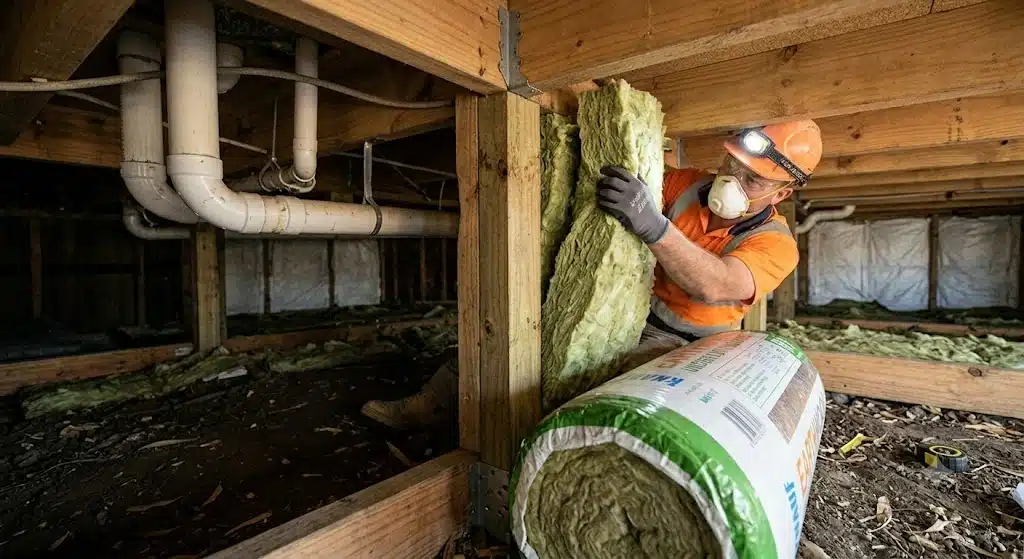
Underfloor Insulation Installation: DIY vs Professional
For homeowners with easy subfloor access and a standard joist layout, DIY installation of batts or reflective foil is achievable. Materials are available from major hardware retailers, and the job can be completed over a weekend for a typical home.
The performance caveat is significant, though. Research into installation quality consistently shows that gaps and poor fit dramatically reduce real-world performance. A 5% gap around the edges of a rigid insulation panel can result in up to 50% more thermal loss than a perfectly sealed installation. Batts that are slightly too narrow for the joist spacing, or that are not securely fixed and begin to sag, deliver a fraction of their rated R-value.
Professional underfloor insulation installation addresses this directly. A trained applicator ensures complete coverage with no gaps, selects the right product for the specific subfloor conditions, and delivers the performance the material is rated for. For spray foam in particular, professional installation is not optional, given the chemical mixing, equipment, and safety requirements involved.
The True Cost: Total Cost of Ownership Over 15 Years
This is the calculation most cost guides leave out, and it significantly changes the comparison.
Consider a typical Sydney home with 100 m2 of raised timber flooring.
Glasswool batts installed today at approximately $15 per m2 comes to $1,500. They’ll likely need to be replaced in 15 years as they sag and absorb moisture in the underfloor environment. Total material cost over 15 years? Approximately $3,000.
Spray foam (closed-cell) installed today at approximately $50 per m2 comes to $5,000, and no replacement is needed. The total material cost over 15 years is $5,000.
Now factor in energy savings. A home spending $2,000 per year on heating and cooling, with a 10–15% reduction in heat loss through the floor, saves $200–$300 per year. Over 15 years, that’s $3,000–$4,500 in energy savings.
The net cost over 15 years: for batts, it’s approximately $1,500 after savings. Spray foam, on the other hand, is approximately $500–$2,000 after savings. The day-one price difference narrows considerably when total cost of ownership is calculated honestly.
Keep in mind these are illustrative figures only and will vary by property, energy costs, and climate zone.
How To Get an Accurate Quote
To get a quote that reflects your actual project rather than a generic estimate, some preparation helps. Measure your floor area, check your subfloor clearance at multiple points, identify the access points into the subfloor, note any obstacles such as pipes or wiring, and flag any moisture issues you have observed. However, a quick budget price based on just the total area is also a good way to get an idea of whether spray foam is the option for you.
When comparing quotes, compare the scope of work rather than just the price. Two quotes covering different R-values, material types, or levels of access preparation are not directly comparable. For underfloor insulation specifically, the product type, coverage method, and any preparatory work should all be clearly itemised before you make a decision.
Get Your Free Site Inspection and Fixed-Price Quote
If you are ready to move forward with underfloor insulation at your residential property or just want an accurate number for your specific home, book a free site inspection with Foamed Insulations. We’ll assess the under-floor insulation installation requirements for your property and provide a fixed-price quote with no hidden costs.
Call 02 9898 0751 to book.
Underfloor Insulation Cost FAQs
How much does under-floor insulation cost per square metre in Australia?
Installed costs range from approximately $15–$20 per m2 for reflective foil, $25–$30 per m2 for glasswool batts, $28–$35 per m2 for polyester batts, and $40–$60+ per m2 for closed-cell spray foam. Prices vary by location, floor area, subfloor clearance, and site conditions.
Is underfloor insulation worth the cost?
For most homes with raised timber floors, yes. Uninsulated floors can account for 10–15% of total heat loss in winter. The combination of energy savings and improved comfort typically makes underfloor insulation a sound investment, with the exact payback period depending on material choice, energy costs, and climate zone.
Can I install underfloor insulation myself?
Batts and reflective foil products can be installed as DIY projects in accessible subfloors. Spray foam must be professionally installed. DIY installations carry a performance risk if fitting is not precise, as a 5% gap around panel edges can cause up to 50% thermal loss.
How long does underfloor insulation last?
Lifespan varies by material. Glasswool batts in underfloor environments typically last 15–20 years before sagging and losing performance. Polyester batts and foil products can last 20–30 years. Closed-cell spray foam lasts 50+ years without degradation.
What’s the best type of underfloor insulation for timber floors?
For overall performance, closed-cell spray foam is the standout option, providing the highest R-value, complete air sealing, and moisture resistance with no maintenance required. For budget-conscious installs with easy access, polyester rolls or glasswool batts are a practical and affordable alternative.
How much can I save on energy bills with underfloor insulation?
Estimates from Sustainability Victoria and industry research suggest underfloor insulation can reduce whole-home heating and cooling costs by 10–15% annually. On a $2,000 annual energy bill, that is $200–$300 per year. Actual savings will depend on the home's existing energy performance, climate zone, and insulation type installed.
