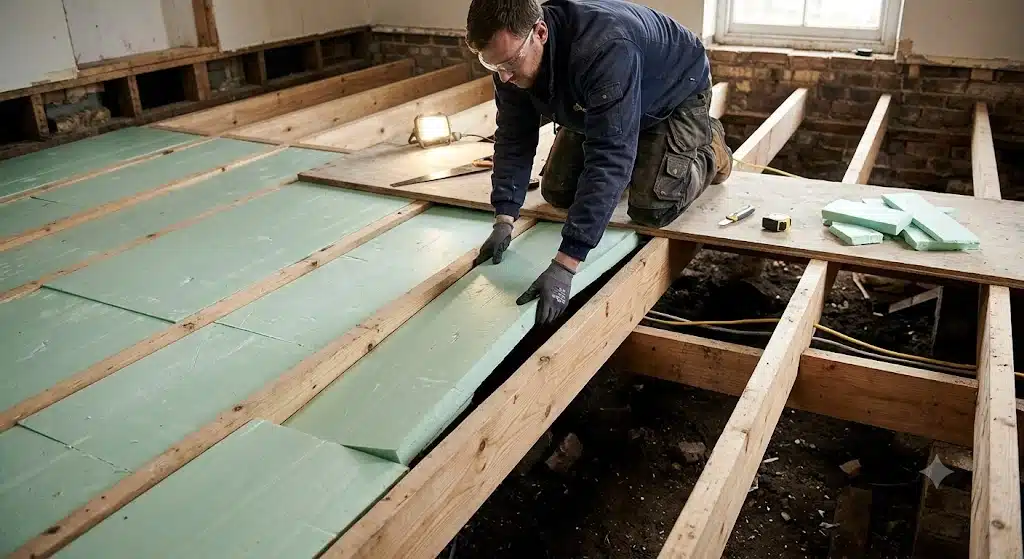
If you own a timber floor home and winters are cold, you already know the problem: the floor is cold underfoot, draughts push up through the boards, and no amount of rugs or heater adjustments fully resolves it.
Underfloor insulation for timber floors is the direct fix, and it works. The question is which type suits your home’s specific situation, given that subfloor clearance, joist layout, moisture conditions, and budget all factor into the right choice.
Why Timber Floors Need Insulation (And What Happens Without It)
Most homeowners reading this already understand why underfloor insulation matters. Uninsulated timber floors can account for up to 20% of total heat loss in a home during winter. That’s a significant and largely preventable share of your heating bill.
Timber floors lose heat through three main mechanisms: gaps between floorboards allow direct air transfer from the cold subfloor below; subfloor vents, designed to provide ventilation and prevent moisture buildup, also draw cold air into the space beneath the floor; and the stack effect, which describes warm air rising through the building, creates negative pressure at floor level that actively pulls cold air upward.
Underfloor insulation is now mandatory in new builds under the NCC (National Construction Code), with minimum R-value requirements varying by climate zone. The catch is that most existing homes, including the vast majority of pre-2003 builds, have no floor insulation at all. Retrofitting is the only path for these properties.
Types of Underfloor Insulation For Timber Floors
Each of the five main insulation types has a genuine place in underfloor applications, and each has real limitations. Understanding both helps you choose the right option for your property rather than the most marketed one.
Glasswool Batts (e.g. Knauf Earthwool, Bradford Optimo)
R-value range: R2.0–R2.5.
Glasswool batts are the most widely available insulation product in Australia. For underfloor insulation for wooden floors, their main weakness is gravity and moisture. They need to be securely strapped or stapled beneath the joists to prevent sagging, and they’ll absorb moisture over time in a damp subfloor environment. Rodents are known to nest in glasswool batts, which can damage the installation over time. For dry, accessible subfloors where budget is the priority, they’re a workable choice.
Polyester Rolls (e.g. Autex GreenStuf, Bradford Polymax)
R-value range: R2.0–R4.0.
Polyester insulation is non-irritant, lightweight, and more pleasant to handle than glasswool, making it a popular choice for DIY installs. It has better moisture resistance than glasswool and doesn’t break down as quickly in damp conditions. It still needs to be strapped or fixed in place, and like all batt-style products, it relies on accurate fitting to avoid air gaps at joist edges. Regardless of the fit, they won’t stop drafts coming through them. For a DIY-friendly retrofit underfloor insulation project with good access, polyester rolls are an option.
Rigid EPS/XPS Panels (e.g. Expol, Foilboard)
R-value range: R1.4–R1.8.
Polystyrene panels are cut and friction-fit between joists, which makes installation straightforward in subfloors with standard joist spacing. They have good longevity and won’t absorb moisture. But they are able to work themselves loose over time. Edge gaps are also a performance risk, as a 5% gap around the perimeter of a rigid panel can result in up to 50% more thermal loss than a perfectly fitted installation. Pests can damage polystyrene, which is worth noting for homes with established rodent activity.
Reflective Foil Insulation (e.g. Foilboard, Bradford Antican)
Reflective foil reflects radiant heat rather than resisting conductive heat flow. Its effectiveness depends on maintaining an air gap on at least one side; without that gap, thermal performance drops considerably. For underfloor use, it performs well as a moisture barrier and radiant heat reflector, but is less effective at reducing conductive heat loss than foam or batt products. It is often used in combination with other insulation types to provide a moisture barrier.
Spray Foam Insulation (Open-Cell and Closed-Cell)
Spray foam is applied as a liquid that expands on contact, filling the entire cavity between and around the floor joists before curing into a continuous insulating layer. There are no gaps at joist edges, no sag, and no fit-and-fix process. It adheres directly to the timber and sets permanently.
Retrofit Underfloor Insulation: What You Need to Know
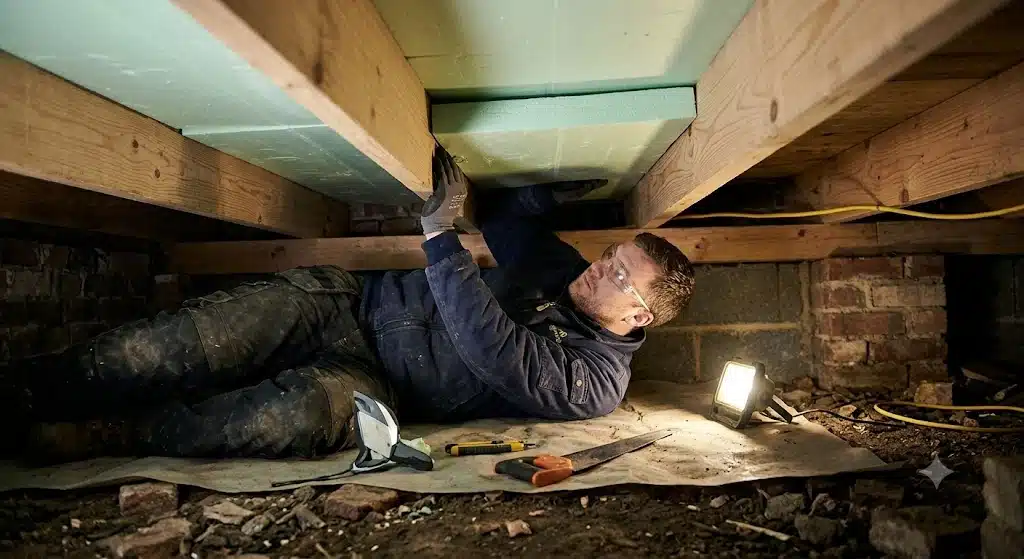
Retrofitting insulation beneath an existing timber floor introduces practical challenges that do not apply to new builds. These are the main factors to assess before choosing a product or getting a quote.
Subfloor Clearance
400mm is the generally accepted minimum for safe access. Below this, retrofit underfloor insulation becomes significantly more difficult and costly across all product types. Spray foam can sometimes be applied in tighter spaces than batts or panels, since an applicator using a spray wand can reach further than someone manually fitting rigid boards, but even spray foam has practical limits at very low clearances.
Existing Wiring and Plumbing
All underfloor insulation methods need to work around existing services. Spray foam will coat pipes and some wiring as it expands to seal everything up. Future electrical or plumbing work is generally not really affected, as new wiring and plumbing can be added at will without interference from the foam spray. This is a consideration for older homes with ageing plumbing, and is worth discussing with your installer before proceeding if you have any concerns.
Irregular Joist Spacing
Pre-war and inter-war homes across Sydney often have non-standard joist spacing that doesn’t align with standard batt and panel widths. Cutting batts to fit reduces their effectiveness and increases labour time. Spray foam is indifferent to joist spacing and fills any configuration automatically.
Debris and Pest Damage
During installation, the team will work around any existing debris in the subfloor space. If there are signs of termite activity, rot, or pest damage, these should be investigated and treated before insulation goes in, as insulating over active pest damage can compound the problem considerably.
Subfloor Ventilation
The external wall vents that provide subfloor ventilation must remain clear regardless of insulation type. Spray foam insulates the underside of the floor above while still allowing air to circulate through the subfloor below. Blocking subfloor vents can lead to moisture buildup and structural risks over time.
Which Insulation Method Suits Your Timber Floor?
- Easy-access subfloor with budget as the main concern and comfort with DIY: polyester rolls or glasswool batts are a practical and affordable choice. The key is complete coverage with no gaps and secure fixing to prevent sag.
- Easy-access subfloor and you want the best long-term performance: closed-cell spray foam applied professionally. Complete seal, no maintenance, lasts the life of the building.
- Low-clearance subfloor or difficult access: spray foam is often the only practical option. An applicator can reach areas that manual installation cannot, and no cutting or panel fitting is required.
- Irregular joist spacing or lots of pipes and wiring: spray foam adapts to any configuration and seals around all obstacles without the fitting challenges that affect batts and panels.
- New build or renovation with floors being lifted: polyester rolls installed from above before the floorboards go down, or spray foam applied from below once framing is complete. Both work well when access is excellent.
- Heritage or period home with specific constraints: closed-cell spray foam provides the best combination of insulation and draught sealing. Where constraints apply to structural elements, batts with a vapour-permeable wrap are an alternative worth discussing with your installer.
The Sydney Timber Floor Problem
Sydney’s housing stock creates a specific version of this challenge. Federation- and Edwardian-era weatherboard homes with suspended timber floors on brick or concrete piers are common across the inner west, the north shore, and the eastern suburbs. Most were built without floor insulation because it was not required under the building codes of the era.Underfloor insulation for existing timber floors in these residential properties is often the single most impactful improvement for comfort and energy performance.
Sydney’s climate (NCC Zone 5) also creates a moisture challenge that makes product selection more important than in drier inland locations. Humid conditions, seasonal temperature swings, and the proximity of many homes to the coast create subfloor environments where moisture management is not optimal. Uninsulated subfloors in these conditions can develop condensation on the underside of the floor joists during winter, contributing to timber degradation over time.
Book Your Free Site Inspection
If you’re serious about insulating beneath your timber floors, start with a free site inspection. Our team will under your house, assess the conditions, and give you a fixed-price quote. For those also concerned about wall cavities, we also offer cavity wall insulation for existing walls.
Call Foamed Insulations on 02 9898 0751 to book.
FAQs
What’s the best insulation for existing timber floors?
For overall performance, closed-cell spray foam is the standout choice for underfloor insulation for existing timber floors. It provides the highest R-value, complete air sealing, and a built-in moisture barrier, with no maintenance required. For budget-conscious homeowners with easy subfloor access, polyester rolls or glasswool batts are a practical alternative.
Can you insulate under timber floors without removing the floorboards?
Yes. All underfloor insulation methods for existing homes are applied from below, through the subfloor space. No removal of floorboards is required. The main requirement is adequate subfloor clearance, generally 400mm or more for safe access.
What R-value do I need for underfloor insulation in Australia?
NCC requirements vary by climate zone. In NSW, Zone 5 (Sydney and surrounds) requires a minimum of R1.5 for underfloor insulation; Zone 6 (southern highlands and elevated areas) requires R2.0. Most installers recommend exceeding the minimum, particularly for high-performance products like closed-cell spray foam, which achieves R3.7–R6.5.
How much does it cost to insulate under a timber floor?
Installed costs range from approximately $25–$30 per m2 for glasswool batts to $35–$60+ per m2 for closed-cell spray foam. For a typical 100m2 floor, expect a broad range of $1,000–$6,000+, depending on material choice, subfloor conditions, and access difficulty.
Is spray foam or batts better for underfloor insulation?
Spray foam is generally the higher-performing option for underfloor insulation for wooden floors. It provides complete air sealing, moisture resistance, and a lifespan of 50+ years without maintenance. Batts are cheaper upfront and sufficient for accessible, dry subfloors where budget is the main concern.
Can I retrofit underfloor insulation myself?
Batts, polyester rolls, and reflective foil can all be installed as DIY projects if your subfloor has adequate clearance. Spray foam must be professionally applied. For DIY installs, careful fitting with no gaps is essential as poor installation can reduce thermal performance by up to 50%.
How long does underfloor insulation last?
Glasswool batts typically last 15–20 years in underfloor environments. Polyester rolls and foil products last 20–30 years. Rigid EPS/XPS panels last 30–40 years. Closed-cell spray foam lasts 50+ years without degradation, making it the longest-lasting option by a considerable margin.
